Estimate catering quantities by counting the guests who will eat, deciding which dishes make up a complete meal, and dividing the portions needed by the caterer’s confirmed portions per tray. Round each dish up to a whole ordering unit, then check that guests with dietary requirements have a complete meal—not just extra sides.
- For catering massapequa searches, compare confirmed meal portions rather than tray names alone.
- Mangia E Bevi offers Italian catering in Massapequa Park; confirm dish yields before ordering.
- Count dietary meals separately, then check each guest has enough suitable food.
- Round up after calculating each dish, not before dividing guests across the menu.
How do you estimate food quantities for catering in Massapequa?
Build your estimate around complete meals, not the number of trays. A tray’s usefulness depends on what it contains, how the food is portioned, and whether the dish serves as a main course or a side.
For a local Italian meal, Mangia E Bevi offers dinner, catering and to-go meals in Massapequa Park. Ask for the current catering choices and the serving assumptions behind each dish before turning your guest count into an order.
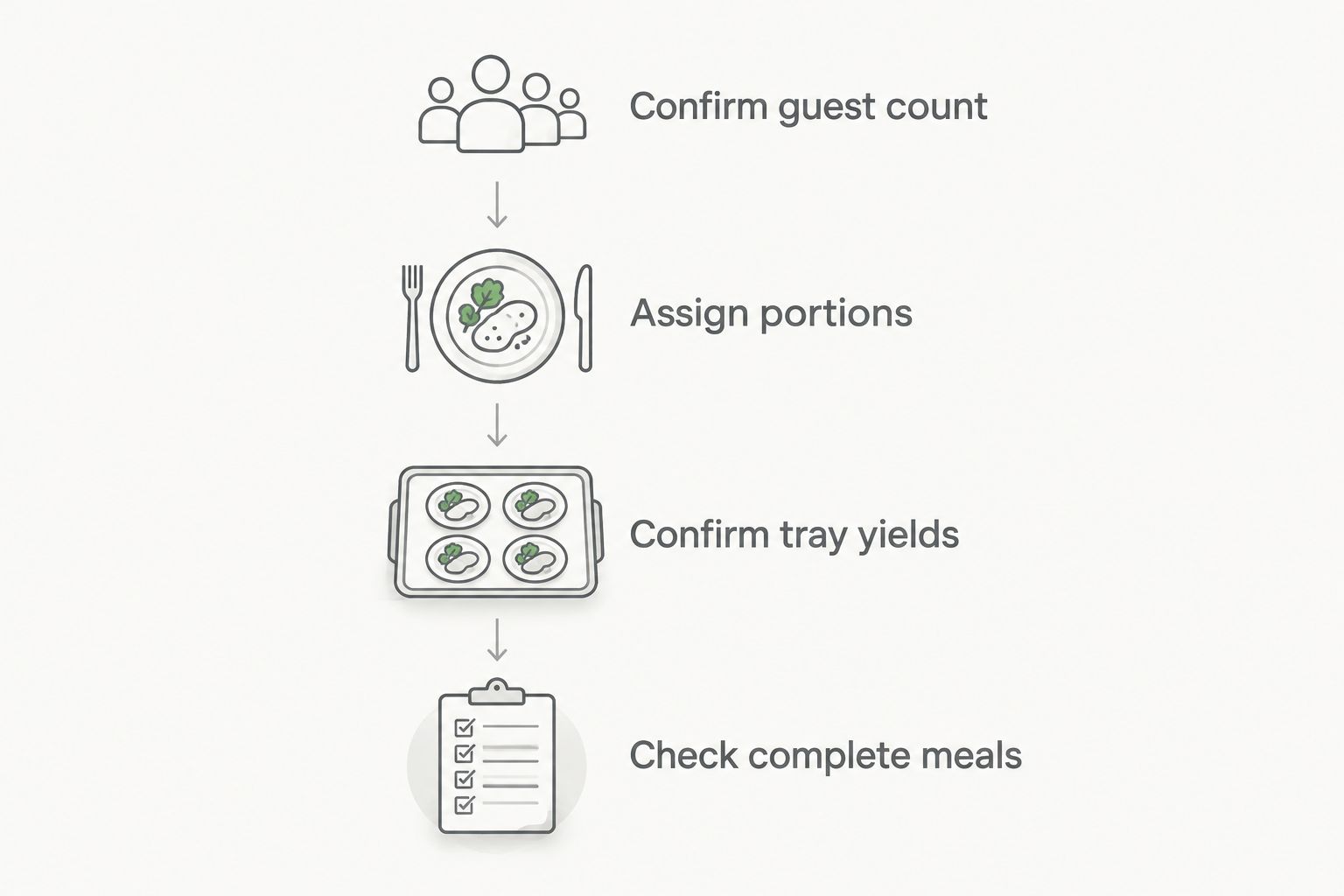
Use this sequence for your 2026 event:
- Confirm the guest count. Separate definite attendees from people who have not replied. Record dietary requirements beside the relevant names.
- Define the meal. Decide whether you are serving a full lunch or dinner, refreshments before another meal, or food alongside a separate host-provided spread.
- Assign portions. Work out which dishes each group will eat. Do not assume every guest needs a full portion of every main.
- Confirm tray yields. Ask how many main-course or side portions each ordering unit provides for your chosen menu.
- Calculate and round. Divide the required portions by the confirmed yield, then round up to a whole tray or other ordering unit.
- Check complete meals. Review the order from each guest group’s perspective, including anyone who cannot eat the shared dishes.
The calculation is straightforward:
Ordering units needed = required dish portions ÷ confirmed portions per ordering unit, rounded up.
The important work happens before that division. A correct calculation still produces the wrong order when the serving assumption does not match your event.
Why this matters
A large spread can still leave someone without dinner. Several shared dishes do not solve the problem if a guest cannot eat their ingredients, and multiple trays do not prove that the main course covers the whole group.
The reverse also happens: treating every dish as a separate full meal creates an order that duplicates portions. Before adding anything, identify what that addition does—complete a meal, accommodate a dietary need, or provide an intentional reserve.
For hosts within a 15-mile radius of ZIP 11762, Massapequa Park provides the geographic anchor for planning. Keep the food quantity calculation separate from collection, transport and serving arrangements; each needs its own confirmation.
Choose the meal format before counting portions
The same guest list needs a different calculation depending on how you serve the food. Choose the format first, then ask the caterer to confirm yields against that format.
| Meal format | Best for | How to estimate | Advantage | Limitation |
|---|---|---|---|---|
| Individually assigned meals | Guests choosing a specific main in advance | Count each selected meal and its accompaniments | Makes dietary and preference tracking clearer | Requires reliable choices before ordering |
| Shared buffet | A group eating from a common selection | Allocate expected portions across mains, then check sides separately | Gives guests flexibility | Self-service portions are harder to predict |
| Food alongside another meal | Hosts already providing substantial dishes | Calculate only the contribution the catering must make | Avoids duplicating the host’s food | Requires a clear account of what is already covered |
Best for a predictable count: individually assigned meals, when that format is offered. The trade-off is administration: someone must collect the choices and keep them accurate.
A buffet suits guests who want to choose at the table, but its estimate needs more thought. If you divide demand across several mains, confirm that each dietary group can actually choose from that selection.
Food ordered alongside a home-prepared meal needs the clearest brief. Tell the caterer which parts of dinner are already covered rather than asking for an unspecified amount of “extra food.”
Turn your guest list into a portion plan
Use a simple worksheet for your 2026 gathering. Put guest groups down the side and dishes across the top, then record the portions each group needs from each dish.
Confirm the guest count
Start with accepted invitations, not the full invitation list. Keep pending responses visible, but separate them from the confirmed order calculation until you decide how to handle them.
Record children separately when their meal requirements differ. Ask about suitable portions rather than applying an automatic fraction of an adult meal; age alone does not tell you what a child will eat.
Assign portions
For guests choosing their own mains, use their actual selections. For a shared menu, decide how demand is distributed across the dishes and review that split with the caterer.
Avoid assigning a full main-course portion of every dish to everyone unless that is deliberately the meal you want. Menu variety and meal quantity are different decisions.
Confirm tray yields
Ask whether a quoted yield describes a main-course serving, a side portion, or a smaller portion within a larger spread. Also ask whether the yield assumes that guests will eat other substantial dishes.
Record the answer beside the dish. A tray label without a serving explanation is not enough information to finish your estimate.
Check complete meals
Read the worksheet by guest group, not just by dish. Each group should have an appropriate main and the accompaniments you intend to serve.
Then read it by dish to calculate the ordering units. This second pass catches the difference between having enough food overall and having enough of the food particular guests can eat.
Why catering quantities vary
Your 2026 estimate should reflect the actual meal rather than a generic allowance per person. Review these factors before approving the order:
- Meal role. Food replacing dinner must cover dinner; food served before another meal has a different job.
- Menu composition. A main dish and its sides need to work together. Counting each independently can duplicate the meal.
- Serving format. Assigned meals and a shared buffet require different ways of tracking portions.
- Dietary requirements. Guests who cannot share the main selection need suitable portions allocated specifically to them.
- Other food provided. Include the host’s dishes in the plan so you do not order the same part of the meal twice.
- Intentional leftovers. Decide whether you want food remaining afterward instead of letting leftovers become an accidental result of rounding.
Make adjustments against a named need. If you cannot explain who will eat an extra tray or what gap it fills, review the calculation before adding it.
How should you account for dietary requirements?
Count dietary meals as part of the guest total, not as an afterthought. Separate the requirements clearly enough that the restaurant can explain which current dishes are suitable and what preparation questions need attention.
Do not assume a dish meets a requirement from its name. Ingredients, sauces and preparation matter, and an allergy requires a direct conversation about handling—not simply removing an ingredient from the description.
The guide to planning an Italian dinner with dietary needs in Massapequa can help structure that conversation. Keep the final suitability confirmation with the restaurant.
For a shared buffet, identify which dishes the dietary group can eat and allocate enough suitable portions. Avoid relying on those guests reaching the food before everyone else.
What should you ask before placing the order?
Send a short, specific brief rather than a guest count alone. For a 2026 event, include the date, intended meal, serving format, confirmed attendance, dietary requirements and any food you are providing yourself.
Ask the caterer to confirm:
- What constitutes a portion for each selected dish.
- Whether each quoted yield assumes a main or side serving.
- Which accompaniments are included, if any.
- How the proposed quantities cover the different guest groups.
- What collection, transport, holding and serving instructions apply.
- When the guest count and order details must be finalized.
Keep those answers with the order confirmation. If the menu or guest count changes, revisit the affected dishes rather than automatically increasing everything.
A useful brief explains the whole meal. It gives the restaurant enough context to question a quantity that looks right on paper but does not fit how you plan to serve it.
When is restaurant dining the simpler choice?
Mangia E Bevi is best for local guests seeking modern Italian dining in Massapequa Park with a stylish, welcoming atmosphere. The restaurant also offers catering, but an at-home meal leaves the host responsible for coordinating the portions and serving plan.
If your real goal is dinner together rather than hosting at home, consider reserving a table instead. You avoid building a tray-by-tray plan, though restaurant dining does not provide the at-home setting some celebrations need.
For a Wednesday or Thursday gathering, check the restaurant’s OpenTable reservation option through its main website. Select the date and party size you need; do not assume a particular time is available.
Plan dinner in Massapequa Park
Explore modern Italian dining and follow the website’s OpenTable reservation option for Wednesday or Thursday.
FAQ
How do I estimate food for catering in Massapequa?
Estimate catering food from confirmed guests, the dishes they will eat and the caterer’s confirmed portions per ordering unit. Divide the required portions by that yield, round up, and check that every dietary group has a complete meal.
How many catering trays should I order?
Order the number of trays produced by dividing your required dish portions by the confirmed portions per tray and rounding up. Confirm whether the yield describes main-course servings or smaller portions within a larger meal.
Should I order a full portion of every main for every guest?
Do not order a full portion of every main for every guest unless that is deliberately your meal plan. Allocate demand across the mains, then check that dietary restrictions do not leave any group short.
How do I count children in a catering order?
Count children separately when their meal needs differ, and ask the caterer about appropriate portions. Do not apply an automatic adult-portion fraction without confirming what those children will eat.
Should dietary meals be extra portions?
Dietary meals belong within the total guest count, with suitable portions assigned to the guests who need them. Add extra food only when it serves an identified purpose, rather than automatically duplicating those guests’ meals.
How much extra food should I order for a buffet?
Set a buffet reserve with the caterer after reviewing the menu, serving format and guest count. A universal extra allowance does not account for which dishes guests can eat or what other food you are serving.
Can I reserve dinner instead of arranging catering?
Mangia E Bevi offers restaurant dining in Massapequa Park as well as catering. For a Wednesday or Thursday dinner, follow the main website’s OpenTable reservation option and check your preferred date and party size.
One last thing
Rounding creates its own reserve. When every dish must be ordered in whole units, rounding each calculation upward can already add food beyond the exact portions required.
Before adding another buffer to your 2026 order, ask how much coverage that rounding provides. Add food to solve a specific shortfall—not simply because the order contains several different trays.